Hinged door in Dubai: why the simplest door is still the everyone trust
A hinged door is a door panel attached to its frame by hinges fixed along one vertical edge, allowing it to swing open and closed on a fixed axis rather than sliding, folding, or pivoting on points set into the floor and ceiling. In Dubai, hinged aluminium doors remain the most widely specified door type for interior rooms, utility entrances, and a large share of villa front doors, mainly because the mechanism is simple, the seal is reliable, and the hardware is far easier and cheaper to maintain over a building’s lifetime than a pivot or sliding system.
My uncle has run a small contracting business in Sharjah for almost twenty years, and I once asked him what hinged-door-dubai type he’d install in his own home without a second thought. He didn’t hesitate. A hinged door, every single time, for the front entrance at least. Not because it’s flashy or because clients ask for it specifically, but because it’s the one type he’s never had to go back and fix six months after installation. There’s something worth paying attention to in that answer, especially coming from someone who’s seen every door type fail in one way or another over two decades of callbacks and warranty claims.
In a market like Dubai, where pivot doors and oversized sliding glass walls get most of the architectural attention, it’s easy to assume hinged doors are the basic, default option everyone settles for when they’re not going for something more dramatic. That’s only half true. Hinged doors earn their place for reasons that have very little to do with being the cheapest or simplest option, and a lot to do with being the option that genuinely works best in specific situations.
It’s worth saying upfront that this isn’t an argument against pivot doors or sliding systems; both have their place, and both do things a hinged door simply can’t. This is more about understanding where a hinged door is actually the smarter choice, not the fallback choice, and why so many of the same architects specifying dramatic pivot entrances are also quietly specifying hinged doors for nearly everything else in the same project.
What Actually Makes a Hinged Door Different
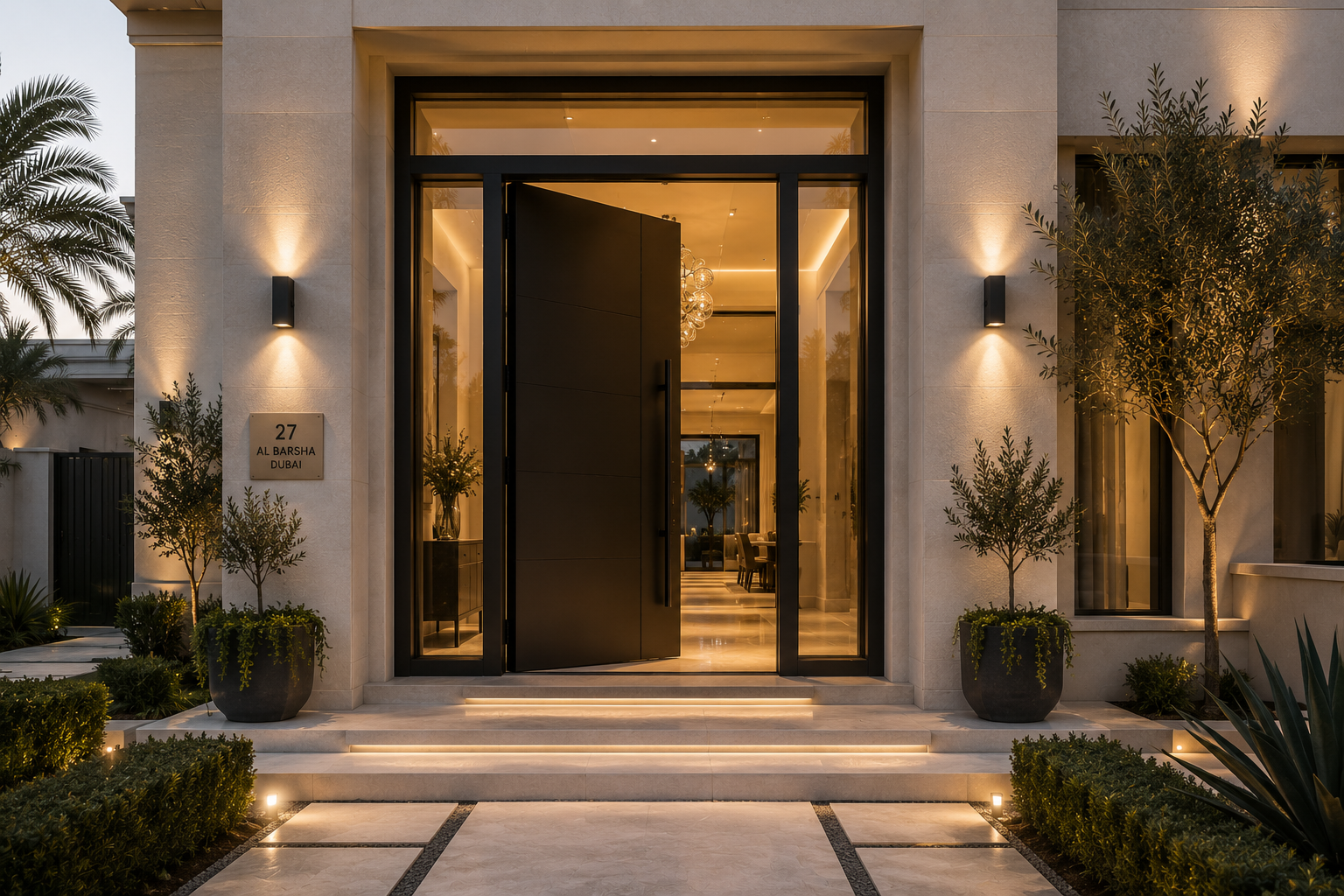
The mechanism is about as straightforward as door hardware gets. Two or three hinges are fixed along one vertical edge of the door panel, attaching it to the frame, and the door swings open on that fixed axis, either inward or outward depending on how it’s installed. No tracks, no pivots set into the floor or ceiling, no motors, just a hinge doing exactly what a hinge has always done.
That simplicity is precisely the point. Fewer moving parts means fewer things that can eventually wear out, and a properly installed hinged door with quality hardware can run for decades with nothing more than the occasional drop of lubricant on the hinge pins. Compare that to a pivot door system, which needs precisely aligned top and bottom pivot points, or a sliding door, which depends on a clean, debris-free track to glide properly, and the hinged door starts looking less like the basic option and more like the low-maintenance one.
There’s also something to be said for how forgiving hinged doors are during installation and over time. A pivot door that’s even slightly out of alignment at the top or bottom pivot can develop a noticeable drag or an uneven seal, and fixing that usually means getting back into the structural elements the pivot is anchored into. A hinged door, by comparison, can often be re-adjusted just by tightening or shimming the hinge plates, a job that takes a technician twenty minutes rather than a half-day callback. For a homeowner thinking about long-term upkeep rather than just the initial installation, that difference matters more than it might seem at first.
hinged-door-dubai Configurations
Single Hinged Doors
The standard configuration, one panel hinged on one side, is used everywhere from front entrances to interior bedroom and bathroom doors. This is the workhorse of the category, and for most openings, it’s genuinely the most practical choice available. A single hinged door also makes the most efficient use of wall space on either side of the opening, since there’s no need to account for a second panel’s swing radius or a parked position the way double doors require.
Double Hinged Doors
Two panels, hinged on opposite sides of a wider opening, meeting in the middle. These show up often on larger entrances, villa front doors, and formal interior openings where a single panel would either need to be unusually wide or simply wouldn’t create the visual presence the entrance calls for. Double doors also give you flexibility, often one panel handles daily use while the second stays latched, only opened for larger gatherings or moving furniture through. This kind of asymmetric use, where one leaf does most of the work and the other stays mostly closed, is actually one of the more underrated practical advantages of going with a double configuration over a single oversized panel.
French Doors
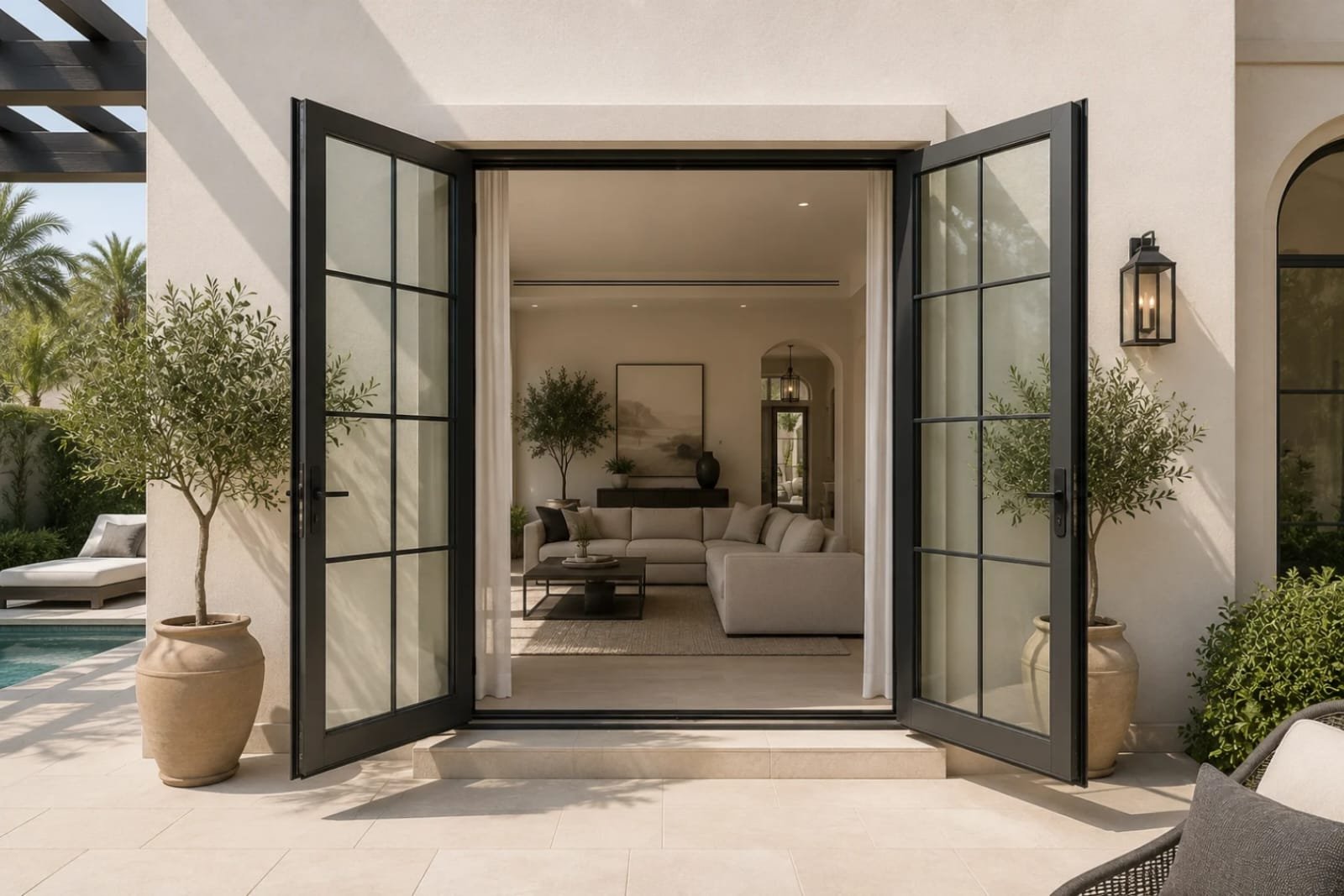
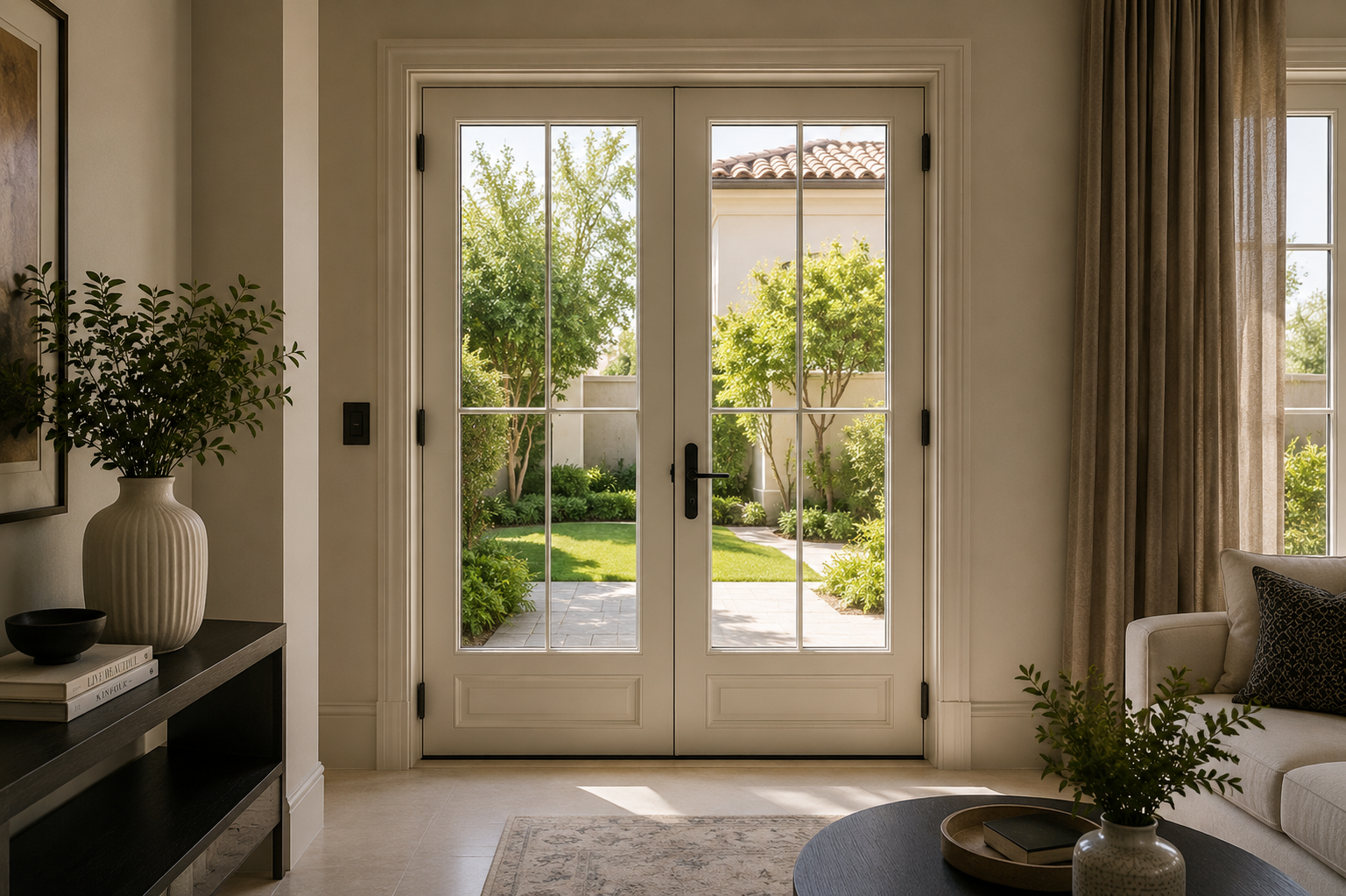
A specific style of double-hinged door, typically with full or partial glass panels, opens from the center outward or inward. These are popular for connecting interior spaces to a garden, balcony, or terrace, offering a wide, symmetrical opening with a more traditional aesthetic than a sliding glass wall. also tend to suit smaller outdoor connections better than a full sliding wall would, since they don’t need the same depth of track or floor-level hardware, which makes them a practical option for renovations where ripping up flooring for a sliding track isn’t really on the table.
Hinged Door Cost: the Argument nobody really talks About
Most conversations about door types in Dubai eventually circle back to the dramatic options, the impressive pivot entrance, the wide sliding glass wall, because those are the doors people photograph and talk about. What gets skipped is the simple math of a real project.
- A villa might have one front entrance but fifteen or twenty interior doors, bedrooms, bathrooms, closets, a study, and utility rooms.
- Specifying anything beyond a hinged door for that volume of openings would push a project’s budget into territory that frankly doesn’t make sense for doors nobody is going to stop and admire.
- This is really where hinged doors do their quiet, unglamorous work. They let a budget stretch further across the doors that need to function reliably every single day without drawing attention to themselves, while leaving room in the budget for one or two genuine architectural statements elsewhere in the project, a pivot entrance, a sliding wall opening onto a pool deck, wherever the design actually calls for something more dramatic.
- Trying to make every door in a house a statement piece usually just means none of them feel special, and the budget that should have gone toward one impressive entrance ends up diluted across two dozen interior doors instead.
Inward vs Outward Swing Hinged Door: A Detail Worth Getting Right
- Whether a hinged door swings inward or outward isn’t just a design preference; it affects safety, weatherproofing, and in some cases, building compliance. Outward-swinging doors are generally preferred for fire egress on commercial properties, since a door that opens away from a room can’t be blocked by a crowd pushing against it from inside during an emergency.
- For residential entrances, outward-swinging front doors also tend to seal slightly better against wind-driven rain, since the door presses into the frame from the direction the weather is usually coming from.
- Inward-swinging doors remain common for interior applications, bedrooms, bathrooms, and studies, mainly because they don’t require external clearance and won’t interfere with a corridor, balcony, or walkway outside the opening.
- The choice usually comes down to where the door sits and what’s on the other side of it, rather than one direction being universally better than the other.
Material and Glazing Choices for hinged-door-dubai
Aluminium remains the dominant frame material for hinged doors across the UAE for the same reasons it dominates window systems here: it resists corrosion, doesn’t warp with heat or humidity, and holds a powder-coated or anodized finish for years without fading. Timber-look aluminium, achieved through a wood-grain powder coat or laminate finish, has become a popular middle ground for homeowners who want the warmth of a wooden door without the maintenance burden timber actually carries in this climate.
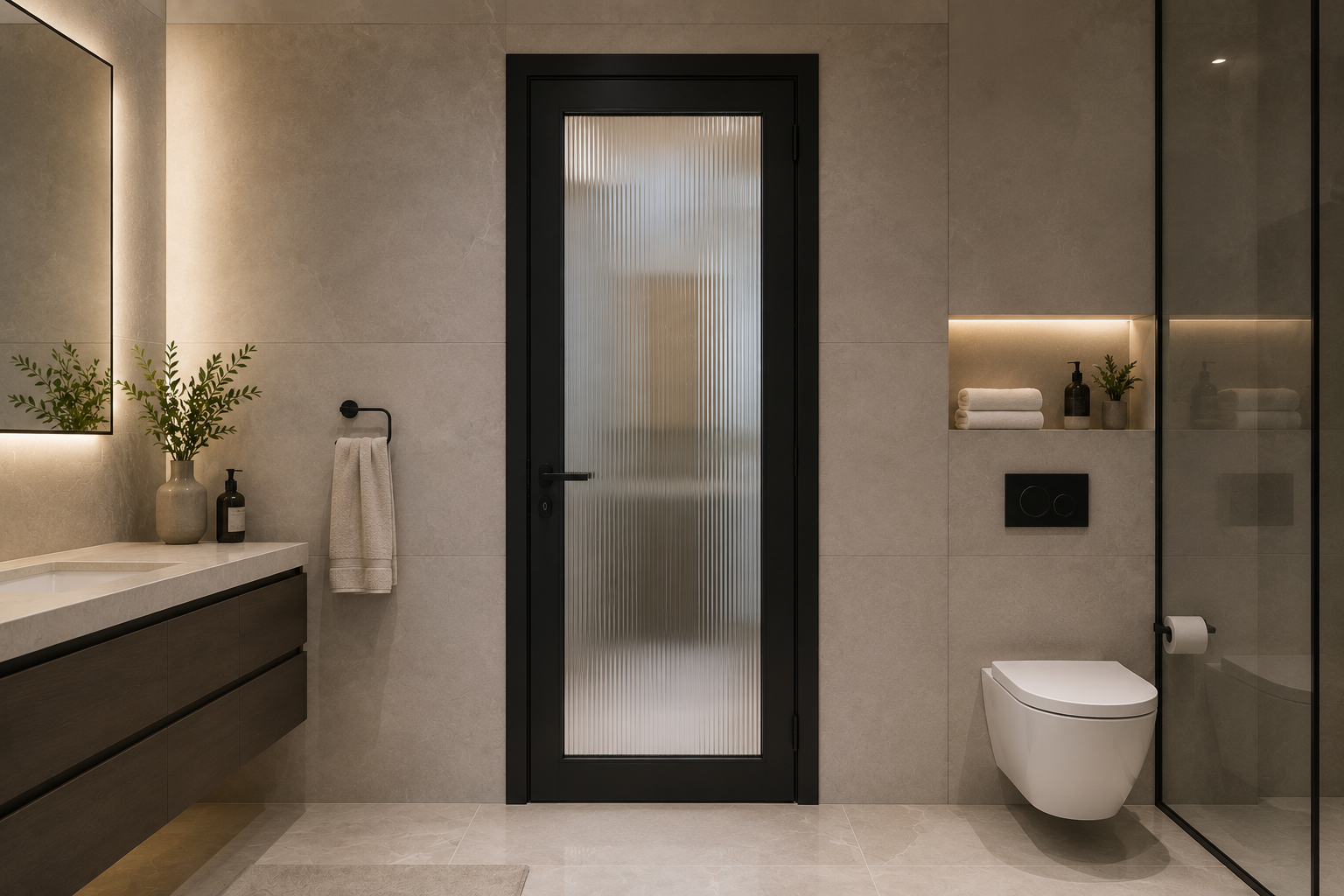
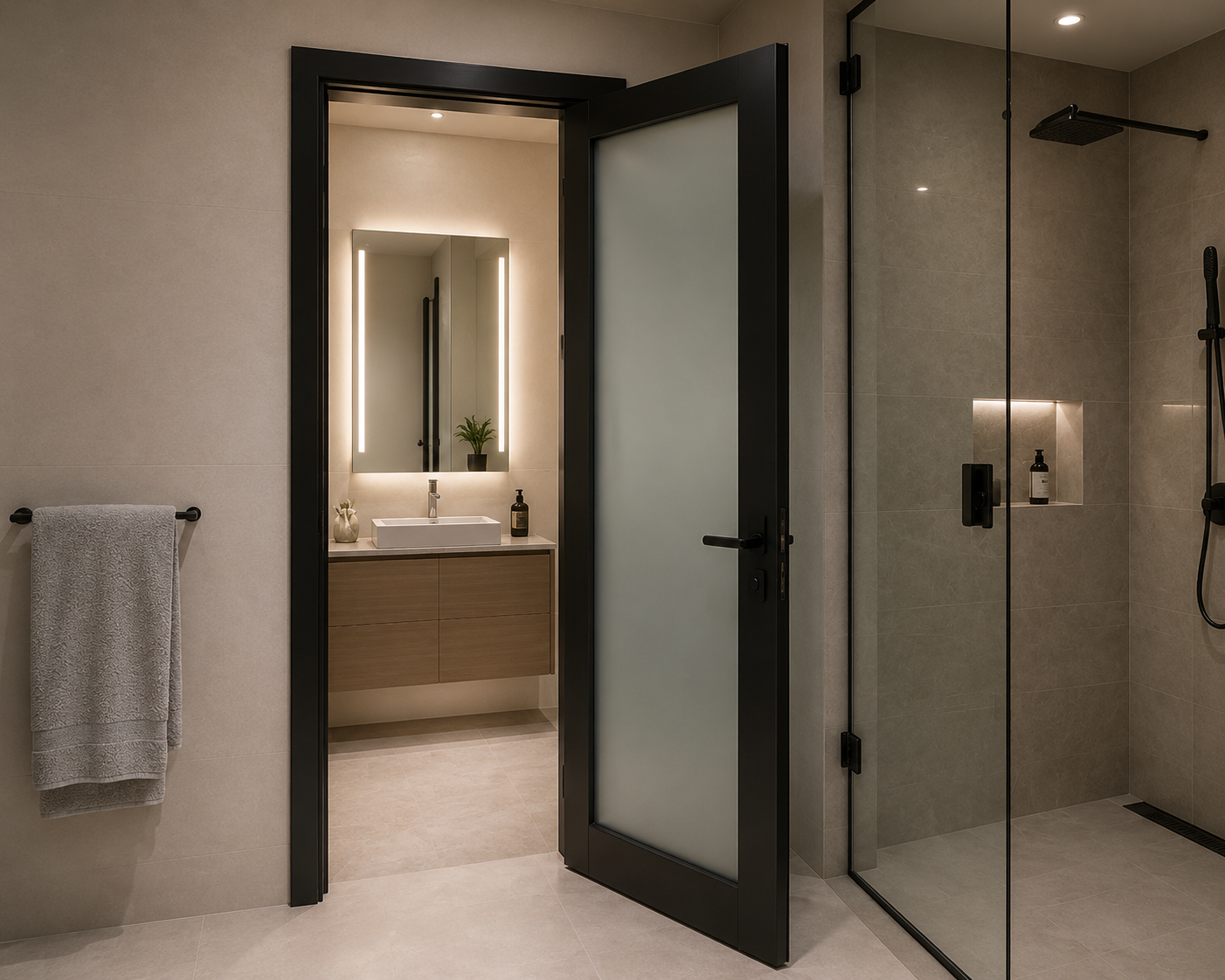
Glazing choice depends heavily on where the door sits. Entrance doors commonly use laminated or tempered safety glass, sometimes with a frosted or tinted finish for privacy without sacrificing light. Interior doors, bedrooms and studies especially, sometimes skip glazing altogether in favor of a solid panel, while bathroom doors frequently use obscured or frosted glass to balance privacy with natural light transfer from an adjoining hallway or window.
Why Hinged Door Still Make Sense in a Market That Loves Pivot and Sliding Systems
Dubai’s residential architecture has leaned hard into dramatic entrances over the past decade: oversized pivot doors, expansive glass sliding walls, statement pieces that double as design features. None of that has actually displaced the hinged door; it’s just shifted where hinged doors get used.
Walk through any villa built with a grand pivot door at the front entrance, and you’ll almost certainly find hinged doors handling every interior room, every bathroom, most bedrooms, and frequently the utility and service entrances too.
There’s a practical reason for that split. A pivot door makes sense as a singular architectural statement, but specifying pivot hardware for every interior door in a house would be wildly impractical and unnecessarily expensiveHinged doors do the job interior spaces actually need: a reliable seal, straightforward operation, and a price point that makes sense across a dozen or more doors in a single project, without sacrificing the security or insulation that a quality aluminium frame provides.
Hinged Door Security and Weather Performance
This is genuinely one of the strongest arguments in favor of hinged doors, particularly for an entrance door rather than an interior application. Because a hinged door closes by pressing the entire panel flat against the frame on all sides, it creates a complete, continuous seal far more easily than a sliding door, where two panels meet at a track-mounted interlock that’s inherently a little more vulnerable to forced entry.
Quality hinged door systems support multi-point locking, where the lock engages at several points along the door’s height rather than just at the handle, distributing force more evenly and making the door considerably harder to force open. Combined with reinforced hinges rated for repeated heavy use, this is part of why hinged doors remain a common choice for front entrances even on properties that also feature a more dramatic pivot or sliding system elsewhere on the facade.
Weather performance follows similar logic. The flat, full-perimeter seal a hinged door achieves when closed handles wind-driven rain and dust intrusion at least as well as other door types, and the hardware involved, hinges and a lock, is mechanically simpler than a pivot or sliding mechanism, which means there’s less that can go wrong during a sandstorm or sudden downpour.
Where Hinged Doors Get Used Most in Dubai Projects
- Front entrances on villas and townhouses where a classic, secure entry is preferred over a statement pivot door
- Every interior door throughout a home, bedrooms, bathrooms, studies, and closets
- Utility entrances, service doors, and staff entrances on both residential and commercial properties
- Office and retail interior partitions where a simple, reliable swing door suits daily foot traffic
- French door configurations connecting interior living spaces to gardens, balconies, or terraces
What Actually Separates a Good Hinged Door From a Bad One
Hinge Quality and Rating
This sounds obvious, but it’s the detail most likely to get quietly downgraded on a cheaper quote. Hinges are rated by the weight and cycle count they’re built to handle, and a hinge undersized for a heavier glass-paneled door will eventually sag or loosen at the screws, no matter how good the rest of the door looks. For heavier doors or anything getting frequent daily use, ask specifically about the hinge load rating rather than assuming all hinges are interchangeable.
Frame and Seal Quality
A thermal break in the aluminium frame matters here exactly as much as it does in a window. Without it, the frame conducts heat straight through, undermining whatever insulation value the door’s glazing or panel material provides. Weatherstripping around the full perimeter of the door is what actually determines how well it keeps out dust and water once installed.
Locking Hardware
A single-point lock at the handle height is the minimum, but a multi-point locking system is worth the modest extra cost for any entrance door, and increasingly common even on quality interior doors in higher-end projects. It’s a relatively small line item that meaningfully changes how secure the door actually is.
Hinged Doors by Arqen Industries
At Arqen Industries, our hinged door systems are built with the same climate-first approach as the rest of our door and window range, with properly thermal-broken frames, reinforced hinges rated for heavy daily use, and multi-point locking available across our entrance configurations. We supply single, double, and French door configurations for villas, apartments, and commercial projects across the UAE, and we work directly with architects and developers to figure out where a hinged door is genuinely the right call versus where a more dramatic pivot or sliding system earns its place instead.
Most projects end up using a mix, and that’s exactly as it should be. The goal isn’t to sell one door type for every opening in a building; it’s to match the right system to each specific door’s job. Our team has installed hinged door systems across coastal villa developments, inland commercial fit-outs, and everything in between, and that range of project conditions, salt air, sandstorm exposure, and heavy daily commercial use, shapes the hardware specification we actually recommend rather than defaulting to one standard option for every client.
Frequently Asked Questions
Are hinged doors less secure than pivot or sliding doors?
Not inherently. A quality hinged door with multi-point locking and reinforced hinges can be just as secure as a pivot or sliding system, sometimes more so, since the full-perimeter seal and lock engagement on a hinged door is mechanically straightforward and well-proven over decades of use. Security comes down to the hardware specification rather than the door type alone; a hinged door fitted with a single basic latch is weaker than a pivot door with multi-point locking, and the reverse is equally true. What matters most is the hinge load rating, the number of locking points engaged when the door is shut, and whether the frame itself includes reinforcement at the strike plate, where most forced-entry attempts apply pressure. For a front entrance specifically, Arqen recommends at a minimum a three-point lock and hinges rated for daily heavy use.
Can hinged doors support large glass panels?
To a point, yes, though there are practical limits compared to a pivot system, which distributes weight through the floor and ceiling rather than side-mounted hinges. For very large or heavy glass panels, generally anything approaching floor-to-ceiling height with substantial glazing, a pivot door is usually the better-engineered choice, since its load path was specifically designed for that scale. For standard-sized openings with moderate glazing, roughly door-height panels with typical residential glass thickness, a properly hinged door with quality reinforced hinges handles the weight without issue and without the added structural work a pivot system requires. The deciding factor is almost always panel weight relative to hinge rating, not glass size on its own, so it’s worth asking a supplier for the maximum supported weight rather than assuming based on dimensions alone.
How long do quality aluminium hinged doors typically last?
With proper hardware and regular maintenance, a well-installed aluminium hinged door can reasonably be expected to perform for twenty years or more in Dubai’s climate, since aluminium itself doesn’t warp, rust, or degrade from heat and UV exposure the way timber or untreated steel can. The hinges and seals are usually the first components to need attention, well before the frame itself shows any real wear, typically requiring lubrication or minor adjustment within the first five to ten years of daily use. Weatherstripping around the perimeter tends to be the next component needing replacement, generally somewhere in the ten-to-fifteen-year range, depending on sun exposure and how frequently the door gets used. The glass, if properly specified, often outlasts the hardware entirely.
What’s the difference between a hinged door and a French door?
A French door is essentially a specific style of double-hinged door, typically featuring full or partial glass panels and opening from the center outward or inward, rather than a fundamentally different mechanism. The underlying hinge hardware is identical to that of any other hinged door, with two panels each hinged on their own side of the frame. The difference is mainly in configuration and the amount of glazing involved; French doors lean toward symmetry and glass for a more traditional, light-filled aesthetic, often used to connect a living space to a garden or terrace. A standard double hinged door, by contrast, might use solid panels or minimal glazing and prioritize security or privacy over the open, light-filled feel French doors are specifically chosen for.
Do hinged doors need much maintenance?
Very little, which is part of their appeal compared to track-based or pivot systems. Periodic lubrication of the hinge pins, roughly once or twice a year in Dubai’s dusty conditions, keeps the swing smooth and prevents squeaking or stiffness from developing. An occasional check of the locking hardware ensures the multi-point mechanism is still engaging evenly across all points, since misalignment here is usually the first sign something needs adjusting. Standard cleaning of the frame and glazing with mild soap and water, avoiding abrasive cleaners that can dull a powder-coated finish, is typically all that’s needed otherwise. Compared to a sliding door’s track, which needs regular dust and debris removal, or a pivot door’s more involved pivot point inspection, hinged door maintenance is genuinely minimal.
Are hinged doors a good choice for a villa’s main entrance?
They can be, particularly for homeowners who want a classic, secure entrance without the added cost and structural complexity a pivot system requires. A hinged front door with quality multi-point locking, a reinforced frame, and a thermal break performs reliably as a primary entrance and tends to be considerably more budget-friendly than a comparable pivot installation. It comes down to personal preference and the architectural statement the entrance is meant to make: a hinged door reads as classic and understated, while a pivot door makes a deliberately dramatic first impression. Both are genuinely solid choices when specified with quality hardware, and many Dubai villas use a hinged door for the main entrance specifically to keep budget available for other design priorities elsewhere in the project.
Can hinged doors be fitted with automatic or motorized opening?
Yes, automatic openers can be added to hinged doors, commonly seen on commercial and office entrances in Dubai, where hands-free access matters for accessibility compliance or managing high foot traffic throughout the day. These systems typically use a motorized arm connected to the top of the door frame, tr